
 English
  Español


Airlaid Napkin Manufacturing Process: How Fibres Become Finished Napkins
Content
- 1 Why Airlaid Napkin Manufacturing Is Not Papermaking
- 2 The Raw Materials That Enter an Airlaid Line
- 3 The Airlaid Napkin Manufacturing Process, Step by Step
- 4 Process Parameters That Decide Napkin Performance
- 5 Quality Control and Defect Troubleshooting
- 6 From Roll to Table: Converting and Customisation
- 7 What Buyers Should Put in a Purchase Specification
- 8 Sustainability and Compliance Considerations
- 9 Frequently Asked Questions About Airlaid Napkin Manufacturing
- 9.0.1 Q1: What is the main difference between airlaid and paper napkin manufacturing?
- 9.0.2 Q2: Which fibres go into an airlaid napkin?
- 9.0.3 Q3: How does the web gain strength without water?
- 9.0.4 Q4: What basis weight is normal for airlaid napkins?
- 9.0.5 Q5: Why do some airlaid napkins shed lint, and how is it prevented?
- 9.0.6 Q6: Can the airlaid process produce printed or shaped napkins?
An airlaid napkin looks simple on a table: a soft, cloth-like square that swallows a spilled espresso in under two seconds. Behind that square sits a manufacturing sequence with almost nothing in common with conventional papermaking. There is no water bath, no wet press, no Yankee cylinder. Fibres travel on air, are bonded with heat or latex, and only then become a napkin through calendering, printing, folding, and packing.
This walkthrough follows an airlaid napkin down the line in the order the steps actually happen, explains which parameters decide the quality of the finished product, and shows how buyers can audit a supplier against those parameters instead of relying on sample-room impressions.
Why Airlaid Napkin Manufacturing Is Not Papermaking
Airlaid is a dry-laid nonwoven technology. Wood pulp is defibred into loose fibres, carried by an airstream to a forming belt, and bonded in place. No water is used at any point in web formation. That single fact governs everything downstream.
In wet-laid papermaking, fibres are suspended in water, and when the water drains, hydrogen bonding develops naturally between cellulose surfaces. That bonding is what gives tissue its strength, and also what makes it dense and crisp. Airlaid has no such opportunity. Because the fibres never sit in a slurry, they do not bond spontaneously, so strength must be engineered deliberately. Either thermoplastic bicomponent fibres are blended in and later melted in an oven, or a polymer emulsion is sprayed onto the web and cured.
The result is a bulky, porous, three-dimensional web. At the same basis weight, airlaid material typically holds several times the internal pore volume of a tissue napkin. For a napkin, pore volume equals absorbency, and it also produces a drape that feels closer to linen than to paper.
| Parameter | Airlaid napkin | Conventional tissue napkin |
|---|---|---|
| Forming medium | Air | Water |
| Typical basis weight | 40 to 80 gsm | 15 to 25 gsm |
| Web structure | Open and porous | Dense and closed |
| Bonding mechanism | Thermal fibre or latex | Hydrogen bonding |
| Hand feel | Soft, textile-like | Crisp, paper-like |
| Water consumption | Negligible | High |
| Drying load | Curing only | Evaporation of process water |
| Converting options | Emboss, print, foil, die-cut | Emboss and light print |
The practical consequence: an airlaid line is shorter and far less water-dependent than a paper machine, but it demands tighter discipline in three places, namely web formation, binder ratio, and calendering pressure.
The Raw Materials That Enter an Airlaid Line
Fluff pulp
Bleached kraft softwood pulp arrives as bales and is hammer-milled into fluff before it reaches the forming head. Napkin-grade pulp is selected for brightness, fibre length distribution, and fines content. Excess fines generate dust, migrate through the forming belt, and create pinholes that show up later as thin spots in the finished napkin.
Binder systems
Three routes dominate. Thermoplastic bicomponent fibres with a sheath that softens at roughly 130 degrees Celsius are blended with the pulp before forming. Powder binders are scattered onto the web and activated in the oven. Emulsion binders, typically vinyl-based or diene-based polymer dispersions, are sprayed onto the moving web and cured. Bicomponent bonding delivers the best bulk and softness; emulsion bonding delivers the highest tensile strength and the lowest linting.
Functional additives
- Pigment dispersions for coloured napkins, dosed at the forming stage or applied as a surface wash.
- Surfactants that tune the speed of water uptake without changing total capacity.
- Wet-strength resins for cocktail napkins that must survive condensation on a glass.
- Dust-control agents that reduce airborne fibre during converting.
- Release aids that prevent stacked napkins from blocking under humid warehouse conditions.
The Airlaid Napkin Manufacturing Process, Step by Step
The diagram below shows the six core stages of a typical airlaid napkin line. Everything after stage six is converting rather than web formation, but it has just as much influence on what the customer sees.
Step 1: Fibre opening and metering
Pulp bales are fed into a hammer mill. Rotating hammers break the sheet into individual fibres, and the fluff is conveyed pneumatically to the forming head. Metering accuracy at this stage decides basis weight consistency more than any other single factor. On a well-run line, the feed rate is monitored continuously, because a drift of even a few percent shows up as visible weight variation across the finished cartons.
Step 2: Web formation
The forming head releases a dilute fibre stream onto the moving belt while a vacuum box beneath the belt draws air through. Vacuum level, head-to-belt distance, and air velocity in the forming zone together control fibre orientation and uniformity. Too little vacuum produces cloudy patches; too much compresses the web and destroys the bulk that makes airlaid desirable in the first place. Belt speed is trimmed against feed rate to hit the target basis weight.
Step 3: Binder application
On thermal lines, bicomponent fibres are pre-blended with the pulp at 12 to 20 percent of total web weight before forming. On chemical lines, a polymer emulsion is applied by spray boom or roller coater downstream of the forming head. Spray uniformity matters enormously: a dry edge or a saturated stripe will survive every subsequent process and appear as a stiff or weak zone in the finished napkin.
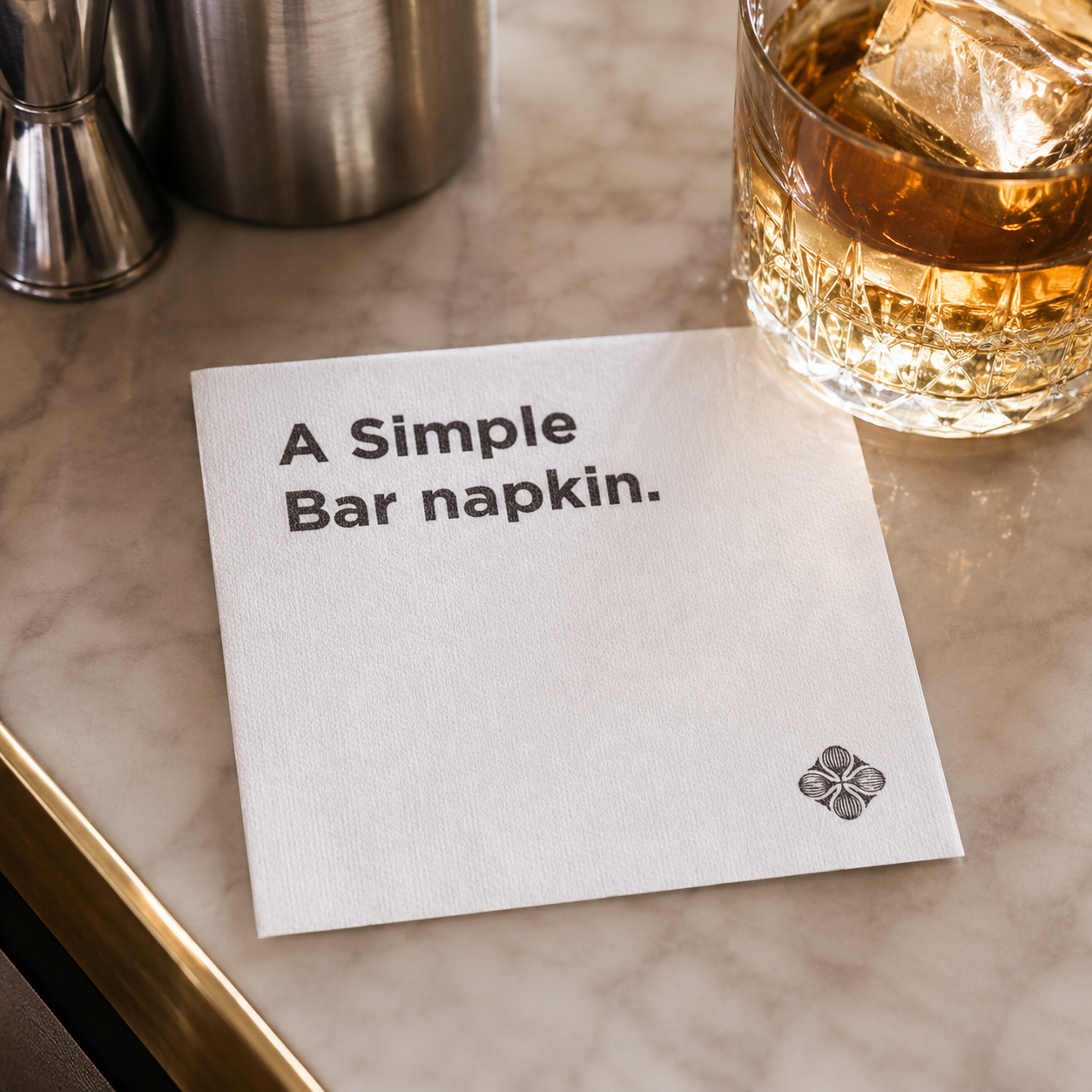 Eco-Friendly Airlaid Napkins ManufacturersAirlaid Napkins White Airlaid NapkinsView Product →
Step 4: Drying and curing
The web passes into a through-air oven where hot air is forced through the sheet rather than only across its surface. Oven zones usually divide into a moisture-evaporation zone, two or three curing zones that activate or crosslink the binder, and a cooling zone that stabilises the web before calendering. Under-curing causes linting and low tensile strength. Over-curing makes the napkin brittle and yellows pale colours.
Step 5: Calendering, embossing, and printing
After the oven, the web is coherent but still relatively flat. A calender stack sets thickness and hand feel. Embossing rolls then imprint texture, ranging from a fine linen grain to diamond or rib patterns. Printing happens here too: flexographic units apply colour patterns, while hot-stamping stations use a heated roll to transfer metallic foil from a carrier film onto the web. Tension control is critical, because a register shift of a single millimetre becomes visible misalignment once the sheet is folded.
Step 6: Cutting, folding, and packing
A slitter trims the web to its final width, and a folding unit produces the finished format. Common folds include quarter fold, sixth fold, and eighth fold. Pocket formats, which hold cutlery inside a folded sleeve, require a separate die-cutting and creasing operation before folding. The final stage counts sheets, compresses the stack, and seals cartons. Accuracy of count and squareness of fold are the two quality markers buyers notice immediately after opening a box.
Process Parameters That Decide Napkin Performance
There is no single setting that produces a good airlaid napkin. Quality emerges from a narrow window across several parameters, and moving one usually forces compensation in another.
| Parameter | Typical working range | Effect on the finished napkin |
|---|---|---|
| Basis weight | 50 to 70 gsm for dinner napkins | Absorbency, stiffness, cost per unit |
| Fluff pulp share | 70 to 85 percent of web | Softness and bulk |
| Binder content | 12 to 20 percent | Tensile strength, linting resistance |
| Forming vacuum | Adjusted to belt speed | Uniformity, web density |
| Oven temperature profile | Zoned, low to high to cooling | Cure level, colour stability |
| Calender pressure | Light to moderate | Thickness, surface smoothness |
| Emboss depth | Pattern dependent | Texture, perceived quality |
| Fold tolerance | Within one millimetre | Stacking, automatic dispenser feeding |
Two of these deserve extra attention. Basis weight is the parameter most often quoted in purchasing documents and the one most often misrepresented in samples, because a supplier can easily run a heavier sample than the production average. Binder content is the parameter most often under-specified, yet it drives linting, which is the single most common complaint from restaurant operators.
Quality Control and Defect Troubleshooting
Airlaid lines are usually monitored at three checkpoints: after forming, after the oven, and after folding. Basis weight, thickness, tensile strength, and absorbency rate are the standard measurements, with colour consistency and lint testing added for printed and coloured products.
| Defect | Probable cause | Corrective action |
|---|---|---|
| Weight variation across the sheet | Unstable fluff feed or uneven vacuum | Recalibrate metering, clean vacuum box |
| Linting and fibre shedding | Under-cured or insufficient binder | Raise cure zone temperature or binder dose |
| Stiff, boardy hand feel | Excessive calender pressure | Reduce nip pressure, review emboss pattern |
| Colour mottling | Uneven pigment dispersion | Adjust dosing point and mixing time |
| Emboss ghosting or flattening | Worn roll or excessive tension | Replace roll, retune web tension |
| Misaligned print register | Tension fluctuation before print unit | Stabilise dancer roller settings |
| Folded edges curling | Residual moisture after cooling | Extend cooling zone, verify moisture profile |
A supplier who can show recorded oven profiles and basis weight logs for a running order is demonstrating process control. A supplier who can only show a perfect hand sample is demonstrating sample-making.
From Roll to Table: Converting and Customisation
The airlaid roll leaving the oven is a semi-finished material. Almost everything a hospitality buyer cares about is added during converting. This is also the stage where the manufacturing footprint of a factory becomes visible, since printing, embossing, foil stamping, die-cutting, and folding each require dedicated equipment and trained operators.
For a closer look at how these steps combine on a production floor, the sequence described in this overview of how airlaid napkins are manufactured maps closely onto the six stages outlined above.
- Embossing: a textured pattern is pressed into the sheet, which adds perceived value and improves grip.
- Flexographic printing: one to four colours applied to a base white or coloured web, used for logos and seasonal motifs.
- Hot stamping: metallic foil transferred under heat and pressure, giving a reflective gold or silver finish.
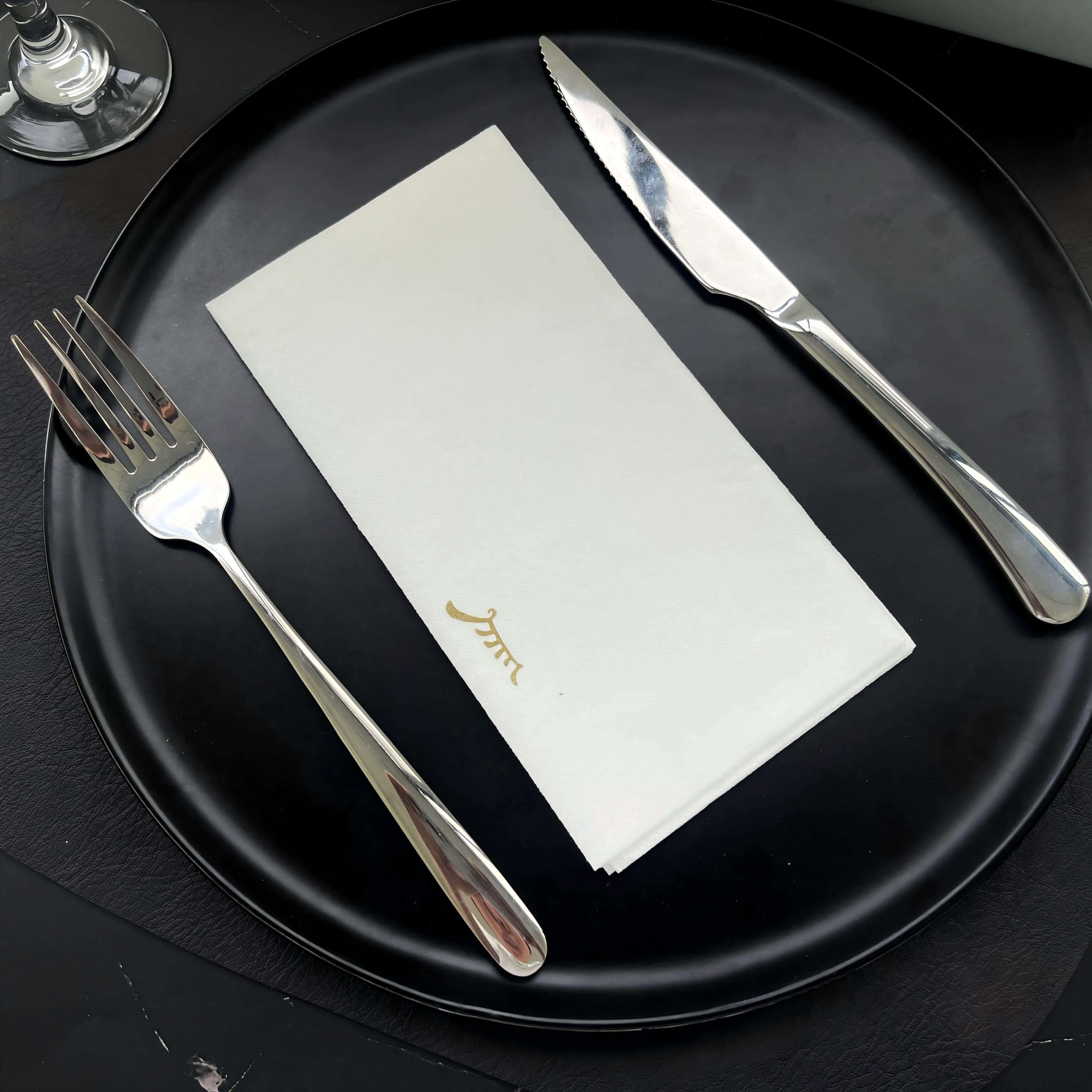
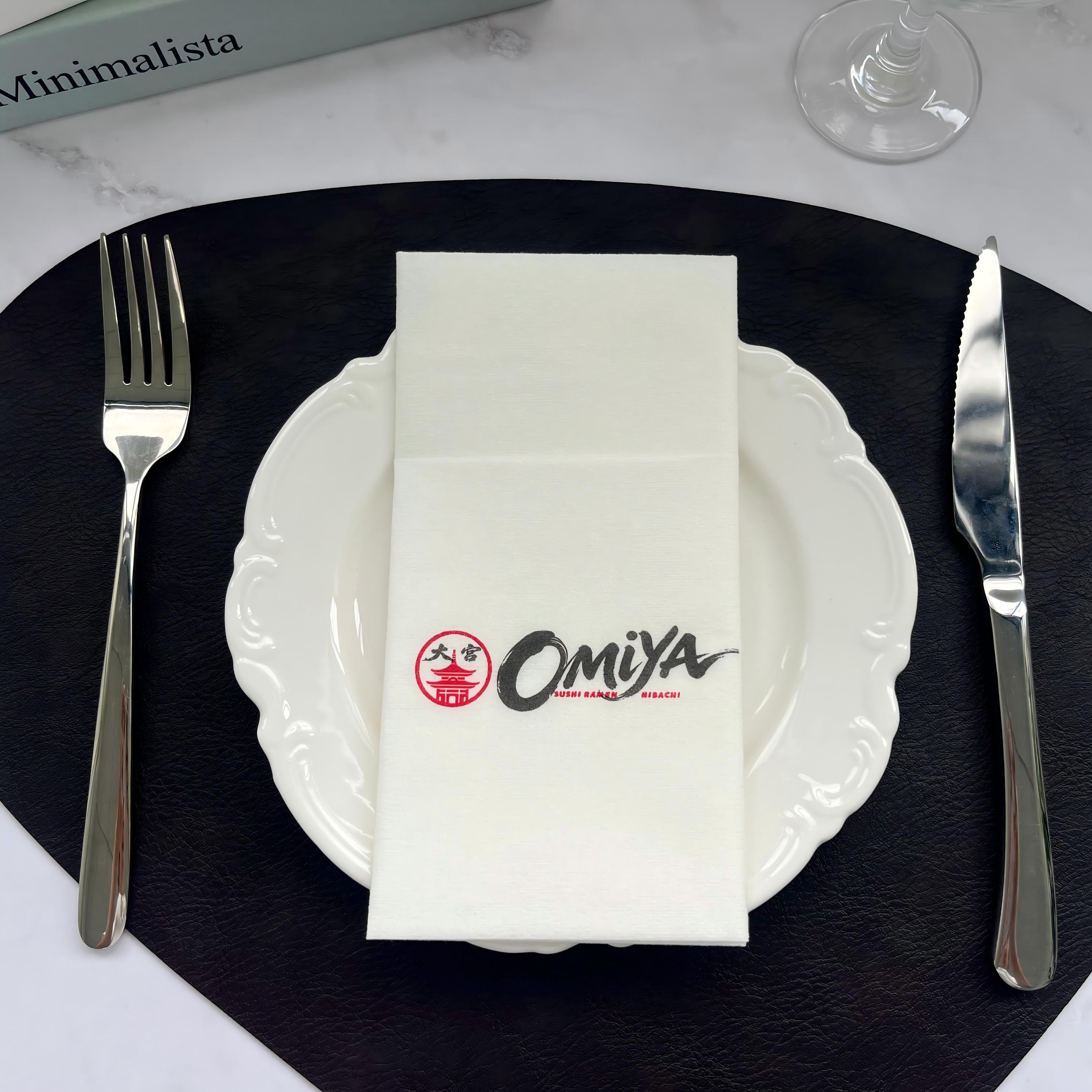
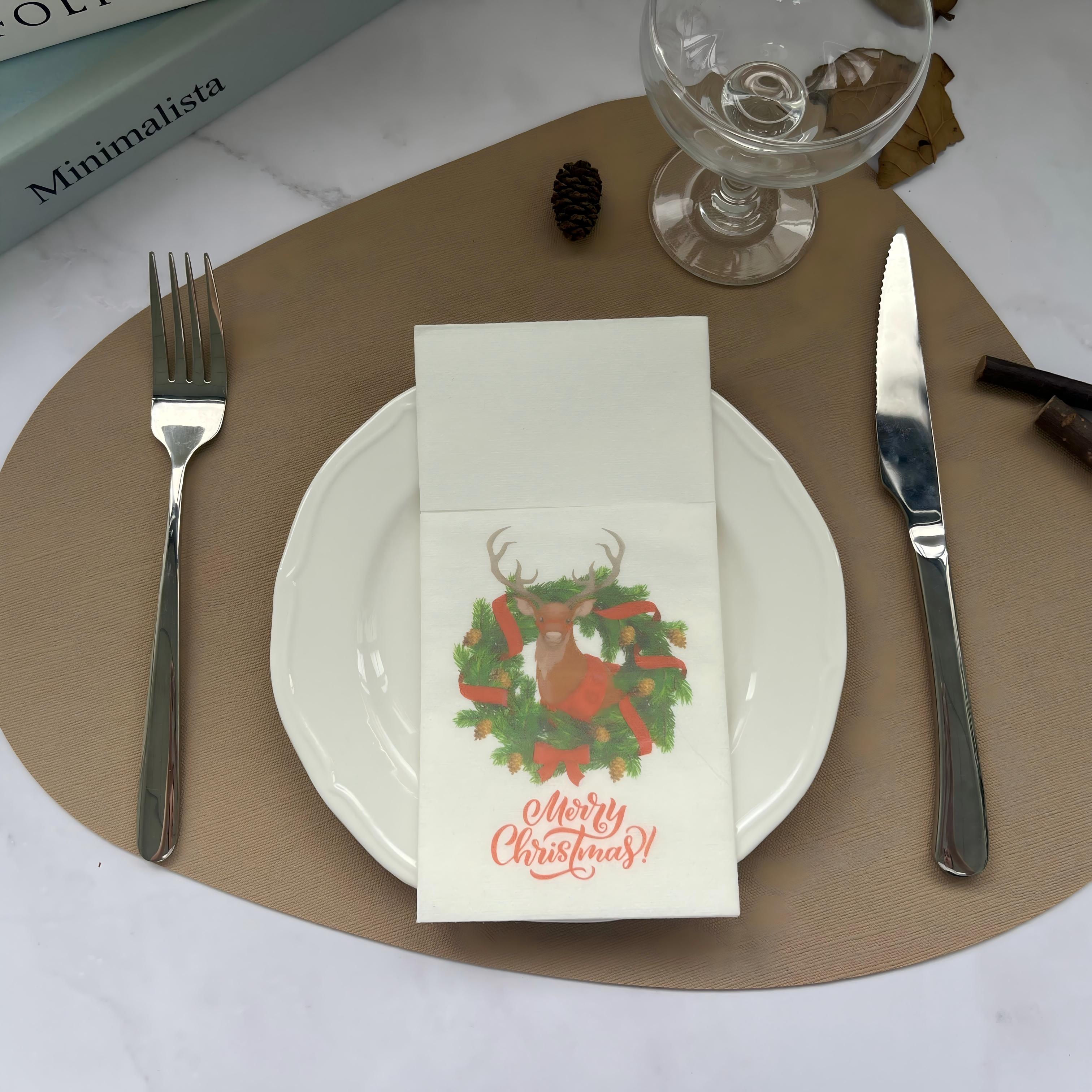
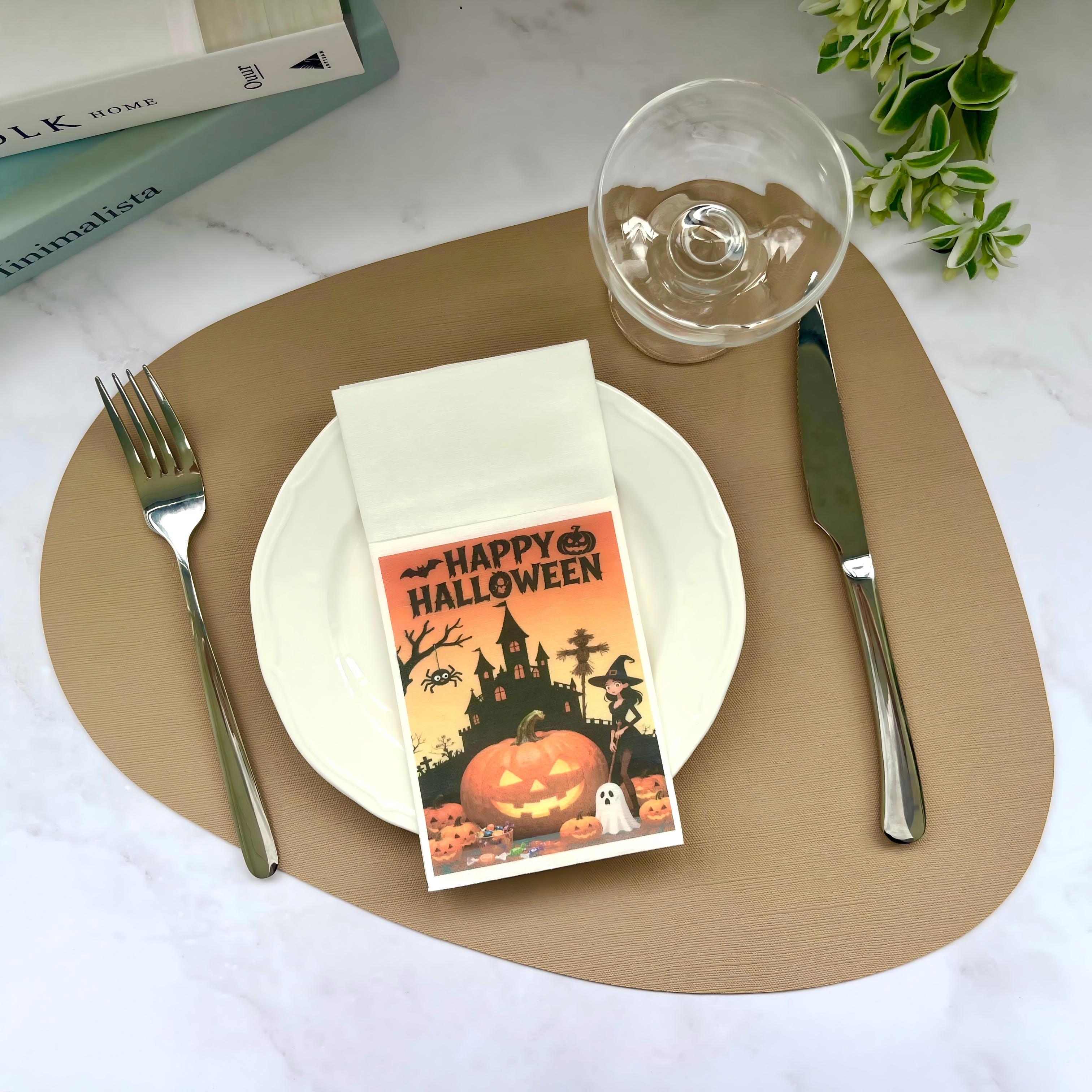
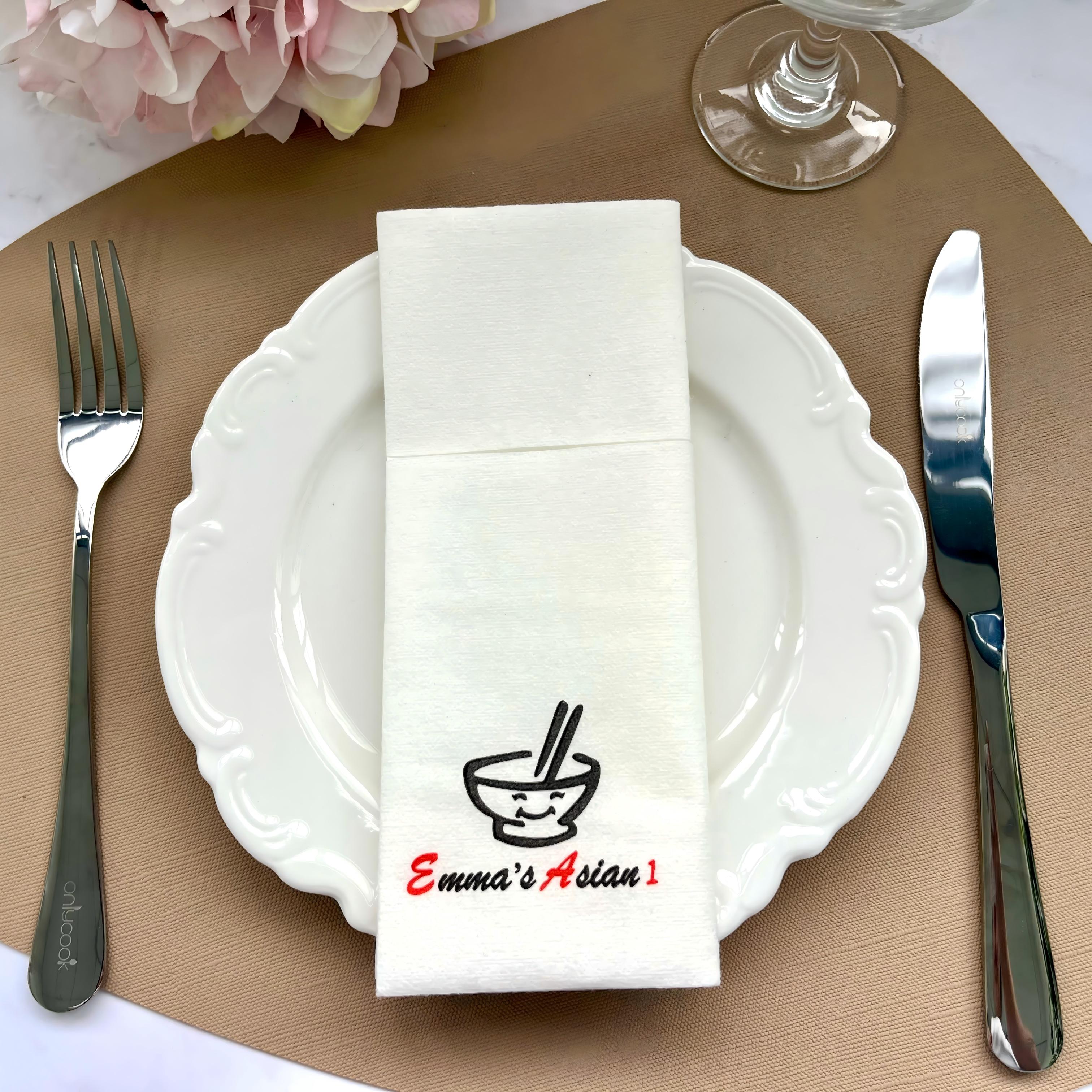
- Pocket and sleeve cutting: a slit and crease pattern that creates a compartment for cutlery, common in banquet and catering service. A representative example of this format is the range of airlaid pocket napkins for table settings.
- Die-cutting: contour shapes such as leaves, flowers, or geometric forms for event and holiday tables.
Because each of these operations adds a pass through the line, converting cost often exceeds fibre cost for highly decorated products. That is why the same base web can be sold as an inexpensive plain white napkin or as a premium decorative item, purely depending on how many converting stages it passes through.
What Buyers Should Put in a Purchase Specification
Most quality disputes in airlaid napkin supply trace back to a vague specification rather than a manufacturing failure. A workable specification covers the following points.
- Basis weight with a tolerance, expressed as grams per square metre plus or minus a stated percentage.
- Sheet dimensions and fold format, including whether the fold is quarter, sixth, or eighth.
- Binder type, since thermal bonding and emulsion bonding behave differently in humid conditions.
- Absorbency requirement, usually expressed as the volume of water taken up within a fixed time.
- Linting limit, which can be agreed through a simple rub test on a dark surface.
- Colour reference, ideally a physical swatch rather than a screen image.
- Packaging format, including napkins per pack, packs per carton, and carton markings.
- Sampling protocol, defining how many production samples will be drawn and at what intervals.
Adding these eight lines to a purchase order takes minutes and prevents most of the disputes that otherwise surface three containers into a supply relationship.
Sustainability and Compliance Considerations
Airlaid has a genuine environmental advantage at the forming stage: it eliminates process water and the associated effluent treatment. The remaining footprint sits mostly in three places.
- Fibre sourcing: pulp that carries recognised chain-of-custody certification is the single largest lever a napkin manufacturer controls.
- Binder chemistry: bio-based and water-based binder systems reduce volatile emissions during curing.
- End-of-life: cellulose-dominant airlaid webs with low synthetic content degrade faster in industrial composting than webs with high thermoplastic content.
For buyers facing packaging and single-use regulations in their own markets, the practical questions to ask a supplier are the fibre origin, the binder chemistry, and whether the finished napkin has been tested under the relevant compostability standard. Claims without documentation are not useful in a compliance file.
Frequently Asked Questions About Airlaid Napkin Manufacturing
Q1: What is the main difference between airlaid and paper napkin manufacturing?
Airlaid forms a web from fibres suspended in air and bonds them with heat or latex, while papermaking forms a web from fibres suspended in water and relies on natural hydrogen bonding. The airlaid route uses almost no process water and produces a bulkier, softer, more absorbent sheet.
Q2: Which fibres go into an airlaid napkin?
Most napkin-grade airlaid consists of 70 to 85 percent bleached kraft fluff pulp, combined with 12 to 20 percent thermoplastic bicomponent binder fibre or a cured polymer emulsion.
Q3: How does the web gain strength without water?
Strength comes from deliberate bonding. Thermal lines melt the sheath of bicomponent fibres in a through-air oven, creating thousands of small weld points. Chemical lines spray a polymer emulsion that crosslinks during curing, forming a continuous film at fibre intersections.
Q4: What basis weight is normal for airlaid napkins?
Cocktail formats commonly run from 40 to 55 gsm, dinner napkins from 55 to 70 gsm, and heavy banquet or pocket formats up to 80 gsm. Higher basis weight increases absorbency and stiffness but also raises material cost.
Q5: Why do some airlaid napkins shed lint, and how is it prevented?
Linting almost always indicates incomplete curing or too little binder. Raising the cure-zone temperature, extending residence time in the oven, or increasing binder content resolves it. Loose surface fibres can also be controlled with a light dusting agent applied during converting.
Q6: Can the airlaid process produce printed or shaped napkins?
Yes. Printing, embossing, and hot stamping are applied after curing, and die-cutting can produce contour shapes. Each additional converting stage increases unit cost, so decoration decisions should be made with the total cost per napkin in mind rather than per process step.
The airlaid napkin manufacturing process rewards precision far more than it rewards scale. A wider web does not fix an unstable feed rate, and a faster line does not compensate for an under-cured binder. The operators who consistently deliver good napkins are the ones who treat basis weight, binder ratio, oven profile, and calender pressure as a connected system rather than four independent dials.
For buyers, that translates into a straightforward evaluation method: ask for the process parameters, not just the sample. A supplier who can discuss oven zones and binder percentages in concrete terms is almost always a supplier who can hold those numbers across a repeat order.

- Contact
-
+86-18205820793lydia@shuangjiepaper.comPhone
- Get Connected

